Packaging Material Solutions for Battery Manufacturing
Battery packaging materials play a crucial role in the lithium-ion battery manufacturing process. Indeed, considerable cost savings can be achieved when an adequate combination of mechanical, permeation, and seal-strength properties is present in the selected packaging material. With the widespread deployment of Lithium-ion batteries to power numerous applications over the course of the last decade, three primary packaging technologies have evolved as the most prevalent in the Lithium-ion battery industry: Cylindrical, Prismatic, and Pouch-based.
Lithium-ion Battery Packaging Solutions
Drawing on the strength of its international manufacturing partner network, Targray has developed an extensive portfolio of lithium-ion battery packaging materials, with solutions to meet the unique needs of each customer.Working in close collaboration with our clients, we develop custom enclosures for the three main battery packaging geometries: Cylindrical, Prismatic, and Pouch. Our solutions include cans, cases, lids, tabs, rolls, and laminated films (aluminum – and polypropylene-based).
Cylindrical Cells and Packaging Materials
The cylindrical cell continues to be one of the most widely used packaging styles for primary and secondary batteries. The advantages to using this cell format are manufacturing convenience and mechanical stability. Indeed, this cell design is easier to manufacture and with a sealed can exterior has the ability to withstand high internal pressures. The cylindrical cell package is also equipped with a resealable vent to release pressure under excessive charge. Applications that predominantly use cylindrical cells include wireless communications, biomedical instruments, power tools and similar applications that do not demand an ultra-compact battery size.
Owing to the popularity of the cylindrical cell geometry, cylindrical cell packaging material is the most commonly available packaging for lithium-ion batteries today.
Prismatic Cells and Packaging Materials
With the advent of portable consumer electronics, use of the prismatic cell design has grown considerably over the course of the last decade. The prismatic cell design supports thinner cell geometries, and its rectangular packaging can be easily customized for each individual application. Lithium polymer batteries exclusively use prismatic cell packaging. Heavier gauge metals are a preferred material option for prismatic casings, as they alleviate the risk of bulging on internal pressure build up.
Pouch Cells and Packaging Materials
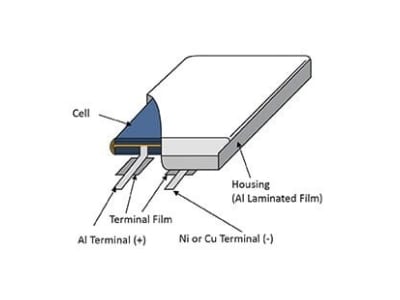
Whereas cylindrical and prismatic cell designs are limited to using hard metallic enclosures, lithium-ion pouch cells can be packaged using conductive multi-layer foils. The electrical contacts in a pouch cell consist of foil tab conduits that are welded to the electrode and sealed to the pouch material. When compared to other cell geometries, pouch cells have the advantage of being lighter and less costly, while also occupying the least amount of space. These characteristics make the pouch cell the preferred option for compact applications such as smartphones, tablets, and other portable consumer electronics requiring ultra-thin enclosures.
Working closely with our supply partners and organizations including the Electrochemical Society and NAATBatt International, we help lithium-ion battery manufacturers worldwide commercialize ambitious new technologies for the energy storage market.
Related Battery Materials
Battery Tab Materials
Our battery tab includes aluminum (Al) tabs for positive electrodes, and copper (Cu) tabs for negative electrodes.
Laminated Battery Tapes
Aluminum Laminate Film

Battery Cases, Cans and Lids

Cathode Materials
Electrolyte Solutions
Copper Foil